Many pencil users are in disbelief about O'BON claiming that our pencils don't break. Now, we are not saying that they never break, but it is damn hard to break the lead in an O'BON pencil. We ask you to do the SMASH test.
The SMASH test involves taking a sharpened O'BON pencil and a wood pencil in one hand. Make sure they are sharpened. Then smash both the pencils on the edge of a table. Don't hit the point, but the body of the pencil. Smash it repeatedly - hard. I mean hard. Now wiggle the point. Still intact, probably both pencils seem to be ok. Now sharpen them.
Test Results:
The O'BON pencil lead is not cracked and works fine. The other pencil lead is cracked and the point wiggles and easily come out when pulled.
How is this possible?
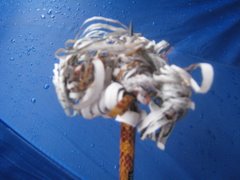
Many think that the O'BON doesn't break because it is cushioned by the newspaper. This is not the correct answer. The O'BON pencil is made by wrapping old newspaper 36 times around the graphite. The graphite is sealed in - airtight. There is no air gap inside, so when the pencil is smashed on the table or drops on the floor, there is no vibration inside the barrel. Wood pencils are made with two slates of wood, grooved for the lead and glued together. There is always an air gap - an air grap allows vibration inside the pencil against the fragile graphite. So, snap, crackle, pop!
Another reason why we claim our pencils are "the world's greatest pencil."
Sunday, November 29, 2009


Friday, November 27, 2009
Do Trees Feel Pain?
I grew up on a 500 acre Virginia farm. So, to heat our log cabin, my brother and I would spend most of the fall weekends cutting wood for our 2 fireplaces and one cook stove. It was fairly arduous work, and we spent a lot of time with chainsaws, two man saw and axes in our hands. My brother thought it was quite funny to raise the specter of trees feeling pain. He would mimic their cry of pain as we felled an old oak. The howl he made was quite chilling, and because it bothered me (I thought it could be true, “Trees feel pain,”) Being only 10 years old when he discovered my uneasy with his chilling scream, he never let it drop. While most weekend lumberjacks would just yell “Timber,” my bro loved to let out his blood curdling, deep throated, vampire-like scream, “Owwwwwwwwwwwwwwwwww.” His pain sound was unique to each tree and although it didn’t drive me home in tears; it almost did.
By the time I took biology in school and learned about nervous systems, it was too late for me to have any logical, scientific basis for the pain denial argument. I had chosen my answer to this question as my brother’s scream was too real, too embedded. Luckily for me, I didn’t hear the carrots scream when I forked them or the broccoli didn’t gasp their last when I chopped and mashed them up with my molars. No, the hypothetical question about trees and pain was only reserved for trees and didn’t transfer to other plants, shrubs, vegetables and flowers.
Now as an adult, I have a different take on this question about our trees. Although I can intellectual accept that a particular tree doesn’t feel pain when it is chopped down, I submit everything else surrounding this tree does feel the pain. Their pain is real. The orangutan, the tiger, the birds, the chipmunk, the snakes, spiders, moles, beetles…..the list goes on, all feel the pain. They don’t just get a bloody nose or a backache; they die. The death isn’t to one animal, one plant, one fungus or one bacteria…the death now results in massive extinction. Malaysia has lost almost all of the world’s oldest rainforest in the 30 years. Since the mid 70s, over 60% of Malaysia was covered with rainforest. It is now less than 20% and dwindling fast. The thousands of species wiped out which we will never find, never know about. The cure for cancer could have been in those wiped our rainforest. But it is not just Malaysia or the Tropics that has suffered so much. Take America, in less than 400 years we have wiped out our forests…with a bare 4% left. Most of these remaining forests are in our National and State Parks (of which, we still allow logging).
The pain of rainforest and other forest destruction is real. Listen to it, “owwwwwwww.” Global warming is a direct result of this painful destruction of our forest. Even though the poor and now pitiful Polar Bear, couldn’t care less about a tree and probably never has even seen one, now starves to death and near extinction looking for a solid sheet of ice to rest. Often these giant, beautiful creatures drown from their exhaustive search for solid ice….a clear painful scream we can all hear and feel. Their painful death is directly attributed to the destruction of our forest. As you watch these majestic creatures struggle to climb a tipsy piece of ice, you can hear their unmistakable scream of a panic death.
So, I thank my brother for teaching me a valuable life lesson. Trees do feel pain, and we can hear and feel pain easily if we listen. The scream can be heard in the Antarctica, Brazil, Vietnam and America. It can be heard loudly in countries where we don’t regulate logging, but it can be heard also in countries that aren’t actively restoring what has been killed.
By the time I took biology in school and learned about nervous systems, it was too late for me to have any logical, scientific basis for the pain denial argument. I had chosen my answer to this question as my brother’s scream was too real, too embedded. Luckily for me, I didn’t hear the carrots scream when I forked them or the broccoli didn’t gasp their last when I chopped and mashed them up with my molars. No, the hypothetical question about trees and pain was only reserved for trees and didn’t transfer to other plants, shrubs, vegetables and flowers.
Now as an adult, I have a different take on this question about our trees. Although I can intellectual accept that a particular tree doesn’t feel pain when it is chopped down, I submit everything else surrounding this tree does feel the pain. Their pain is real. The orangutan, the tiger, the birds, the chipmunk, the snakes, spiders, moles, beetles…..the list goes on, all feel the pain. They don’t just get a bloody nose or a backache; they die. The death isn’t to one animal, one plant, one fungus or one bacteria…the death now results in massive extinction. Malaysia has lost almost all of the world’s oldest rainforest in the 30 years. Since the mid 70s, over 60% of Malaysia was covered with rainforest. It is now less than 20% and dwindling fast. The thousands of species wiped out which we will never find, never know about. The cure for cancer could have been in those wiped our rainforest. But it is not just Malaysia or the Tropics that has suffered so much. Take America, in less than 400 years we have wiped out our forests…with a bare 4% left. Most of these remaining forests are in our National and State Parks (of which, we still allow logging).
The pain of rainforest and other forest destruction is real. Listen to it, “owwwwwwww.” Global warming is a direct result of this painful destruction of our forest. Even though the poor and now pitiful Polar Bear, couldn’t care less about a tree and probably never has even seen one, now starves to death and near extinction looking for a solid sheet of ice to rest. Often these giant, beautiful creatures drown from their exhaustive search for solid ice….a clear painful scream we can all hear and feel. Their painful death is directly attributed to the destruction of our forest. As you watch these majestic creatures struggle to climb a tipsy piece of ice, you can hear their unmistakable scream of a panic death.
So, I thank my brother for teaching me a valuable life lesson. Trees do feel pain, and we can hear and feel pain easily if we listen. The scream can be heard in the Antarctica, Brazil, Vietnam and America. It can be heard loudly in countries where we don’t regulate logging, but it can be heard also in countries that aren’t actively restoring what has been killed.
Tuesday, October 27, 2009
How do we make our pencil?
Many have written to ask how we make our pencils. The process of making a recycled newspaper pencil is relatively easy if you happen to have the secret formula, exclusive machines, 40 staff, a large building and a commitment to excellence. It is really simple to make a cheap, toxic and crappy recycled newspaper pencil. There are plenty of imitations and "fly by night" factories doing this right now. Even though they try, no one comes close to the O'BON recycled newspaper pencil. Enough...let's describe the process.
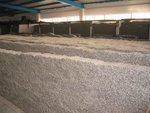
It all starts with the newspaper. The used newspaper has to be cleaned and pressed out so that each paper, each sheet is absolutely flat. There can be no crinkles and lines as well as no chewing gum. Crumbled paper won't do. In short, the used newspaper has to be clean and flat. Once our team goes through each sheet for cleanliness, the paper is laid flat and stacked. Then a two ton flat concrete block is lowered to press the paper flat. The weight stays for a least a week.
Once the old newspaper is flatten, we cut it to the precise length of a pencil. One sheet of standard newspaper is cut into six sheets, thus six pencils can be made from one sheet of newspaper. The length is long enough for 70 revolutions (wrap around the graphite. We often add an additional small length of recycled plain paper for pencil we plan to paint.
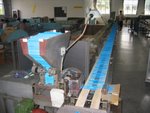
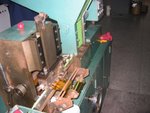
Once the paper is cut and stacked, the pile of newspaper heads to another room to be wrapped and glued. First a half inch fold is made at the top of the paper and the graphite with a small amount of non-toxic, water based glue is added. These are stacked into groups of one thousand. These are carried over to the nearby first machine which thread the graphite filled newsprint into a machine that wrap the pencil. The key to this process is that a small amount of water based glue is dripped onto the newspaper as the machine wraps the pencil tight. So, with each revolution of the newspaper some glue is added. This gives the O'BON pencil a tight, solid, firm feel as the glue hardens.
The hardening of the O'BON pencil involves two steps. First we place the pencils on racks so they can air dry. They will sit on this rack for one to two days. After air drying, the pencils are taken to a big machine where they are heated to 60 degrees Celsius (that's hot). They will be hot air dried in this machine for four hours. This process hardens the glue so the pencil's characteristics are solid and firm.
Out of the heater, the pencil looks rough. It has rough edges and the ends are ragged. So, we sand them smooth and cut off the ends. The machines that sand the pencils and make the O'BON pencil smooth are quiet, and the newspaper dust is collected from the sanding basket and blown into large water vats. Here the newspaper dust turn into a harmless sludge which is filtered. We put the dried remains on our vegetable garden and as mulch around our surrounding trees.
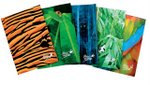
Now the smooth, firm pencil is ready to be painted. We have two systems for this. We have machines that print on our world famous "art." We make high quality film that prints on the pencil our Tiger, Leopard, Elephant, Bear and Parrot. This is how we get our high quality print on the pencil. The other system is where the pencil is painted a single color. The pencils are forced through a small box filled with the paint. As the pencil comes through the box, the excess paint is scraped off with flexible plastic rings. The pencil then rests on a long conveyor belt and the fine layer of paint is given time to dry as it circles on the belt. Then it is forced through the paint box again. A total of at least ten circles and paint layers for each pencil results in an ultra smooth painted surface.
After the paint is applied, the ends are sanded creating a small inverted indentation. The pencils are put upside down into a holder. There will be a hundred pencils in each holder. The holder is lowered (usually less than one inch) into a big vat of paint. Because of the indentation on the end, the dip into the paint results in a smooth and stunningly beautiful "cap." It isn't a cap, but it sure looks like it.
Once dried from the dip, the O'BON pencil is ready to be gently nestled into it's box.
It all starts with the newspaper. The used newspaper has to be cleaned and pressed out so that each paper, each sheet is absolutely flat. There can be no crinkles and lines as well as no chewing gum. Crumbled paper won't do. In short, the used newspaper has to be clean and flat. Once our team goes through each sheet for cleanliness, the paper is laid flat and stacked. Then a two ton flat concrete block is lowered to press the paper flat. The weight stays for a least a week.
Once the old newspaper is flatten, we cut it to the precise length of a pencil. One sheet of standard newspaper is cut into six sheets, thus six pencils can be made from one sheet of newspaper. The length is long enough for 70 revolutions (wrap around the graphite. We often add an additional small length of recycled plain paper for pencil we plan to paint.
Once the paper is cut and stacked, the pile of newspaper heads to another room to be wrapped and glued. First a half inch fold is made at the top of the paper and the graphite with a small amount of non-toxic, water based glue is added. These are stacked into groups of one thousand. These are carried over to the nearby first machine which thread the graphite filled newsprint into a machine that wrap the pencil. The key to this process is that a small amount of water based glue is dripped onto the newspaper as the machine wraps the pencil tight. So, with each revolution of the newspaper some glue is added. This gives the O'BON pencil a tight, solid, firm feel as the glue hardens.
The hardening of the O'BON pencil involves two steps. First we place the pencils on racks so they can air dry. They will sit on this rack for one to two days. After air drying, the pencils are taken to a big machine where they are heated to 60 degrees Celsius (that's hot). They will be hot air dried in this machine for four hours. This process hardens the glue so the pencil's characteristics are solid and firm.
Out of the heater, the pencil looks rough. It has rough edges and the ends are ragged. So, we sand them smooth and cut off the ends. The machines that sand the pencils and make the O'BON pencil smooth are quiet, and the newspaper dust is collected from the sanding basket and blown into large water vats. Here the newspaper dust turn into a harmless sludge which is filtered. We put the dried remains on our vegetable garden and as mulch around our surrounding trees.
Now the smooth, firm pencil is ready to be painted. We have two systems for this. We have machines that print on our world famous "art." We make high quality film that prints on the pencil our Tiger, Leopard, Elephant, Bear and Parrot. This is how we get our high quality print on the pencil. The other system is where the pencil is painted a single color. The pencils are forced through a small box filled with the paint. As the pencil comes through the box, the excess paint is scraped off with flexible plastic rings. The pencil then rests on a long conveyor belt and the fine layer of paint is given time to dry as it circles on the belt. Then it is forced through the paint box again. A total of at least ten circles and paint layers for each pencil results in an ultra smooth painted surface.
After the paint is applied, the ends are sanded creating a small inverted indentation. The pencils are put upside down into a holder. There will be a hundred pencils in each holder. The holder is lowered (usually less than one inch) into a big vat of paint. Because of the indentation on the end, the dip into the paint results in a smooth and stunningly beautiful "cap." It isn't a cap, but it sure looks like it.
Once dried from the dip, the O'BON pencil is ready to be gently nestled into it's box.
Tuesday, November 11, 2008
Thursday, October 23, 2008
Flickr and O'BON
O'BON USA has created a visual display of each O'BON product. Help yourself and enjoy the wonder of these products. Get it here.
Friday, October 17, 2008
Link with us!

Eco-Friendly Stationery

Eco-Friendly Stationery
LINK TO US!
1) Copy the code from the boxes below the image (or images)
2) Then, go onto your website/blog and paste it.
3) The flash image should appear on your website!
4) Need help? Drop me a comment.
If you want us to link with you please send me your link or website!
Sunday, August 31, 2008
Eco-Friendly Office Paper: It's new from O'BON!

We have announced that O'BON is using SugarCane Paper in all our notebooks. This may need some explanation to all our O'BON fans. Why SugarCane Paper? First, when we looked at recycled paper, we were not too impressed with most of it. For example, recycled paper tends to either be brownish and with "threads" embedded. When we looked carefully at the "whiter" paper, we discovered that of this type recycled paper only had a 40% recycled content. This was just too low for us.
As we acknowledge that our SugarCane paper is not recycled paper, it is 86% sugarcane. This leaves a small percentage of actual wood in our paper. Furthermore, given the nature of sugarcane, it is so much easier to make sugarcane paper than wood paper or recycled paper. Many of you know that the paper industry collectively is the 3rd biggest pollution on our planet. So, O'BON really wanted to look for "something different." We think the solution to the paper pollution large footprints is looking at alternatives to the wood paper industry. So much energy and pollution is caused by this business, we need desperately to find solutions.
The wood paper industry destroys huge tracks of forest and rainforest. Moreover, the amount of energy to grind it down to pulp is fantastic. It made sense to us to look at sugarcane as an alternative.
Sugarcane is a plant that grows in the tropics and semi-tropics. It grows quickly in clumps. It does not require heavy doses of fertizers to make it grow quickly. It is more like a weed. It just grows and grows. Two or three "harvests" can be taken each year from this fast growing plant.
The sugarcane is very fiborous and sweet juice is extracted easily with a simple press. Once the juice is extracted, it is usually thrown away. So, why not put it on a truck or ship and take it to a paper mill? Here, the already stripped plant can be made into the pulp necessary to make our sugarcane paper. No big saws or gigantic grinders are necessary for sugarcane pulp paper.
Join us in embracing this type of paper for your office or school printing needs. We call our sugarcane paper: L'Papier d'eco. This paper comes in 80 grams with 500 sheets in one packet. Look for this soon at eco-friendly shops and web outlets.
Subscribe to:
Posts (Atom)